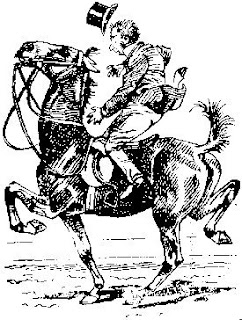
"Lessons? Why? It's Just Like Sittin' in a Chair, Isn't It?"
Do you train people to ride horses or horses to be ridden? If so, how do you react when someone who has revealed an ignorance of ANY type or school of equitation says, "Can I ride your horse?"
Are you a casual rider with little or no formal schooling? Have you ever asked someone who lives and breathes horses, "Can I ride your horse?" Ever get an evasive or downright hostile response?
For the trainers, I suggest this line by long dead British horseman Colonel M. F. McTaggart: "I can guarantee that a horse is perfectly schooled. I cannot guarantee that anyone else can ride him."
For the casual riders, I suggest pondering another McTaggart gem: "Most people do not ride; they are conveyed."
The suggestion of LESSONS leaves many non-horsemen perplexed. While otherwise informed and intelligent, too many are totally unaware of the spectrum of aids and cues, theories and schools, all of which focus on how to get horses to do as we wish.
Many tell me they don't want lessons because they "just" want to ride my horses for "fun." As if I ride because it makes me miserable?
Typically, these folks just don't know that experienced riders use subtle aids and cues. Furthermore, they simply don't know what could happen if they were to make the wrong moves. For example, lean forward and clutch the reins on Lion. He's a model trail horse for those with a basic dressage or western seat, but he also raced for five years. Consider jockey position, then guess what he might do if someone went into a crouch and took a strong hold on the reins. He still LOVES to run and would probably hit 35 miles an hour within a couple of strides.
How could that lean and clutch happen? When something unexpected happens--for example when a horse spooks at a piece of plastic--instinct curls surprised, frightened people into the fetal position to protect their bellies. Unfortunately, this's a good way to invoke a runaway even on a horse that wasn't a professional racer. British riding instructor Heather Moffett refers to this reaction as the "fatal crouch."
Instincts do not make us good horsemen. For most of us, it's learning to override our instincts that makes us good horsemen. We learn to relax and stay with the moment and the movement. Easily said, not easily done.
Horses are prey animals and hence prone to sudden defensive movements. Hot-blooded horses like Arabs and Thoroughbreds can turn this into an art form. I still remember Razz suddenly lurching about fifty feet down a hill when I was on a trail ride. To my surprise, when I finally pulled myself upright--with my abs, NOT the reins--he immediately dropped back to a walk. He trusted my assessment that whatever frightened him didn't frighten me, so he relaxed.
So my conclusion is that most people who ask "Can I ride your horse?" have simply never ridden a hot or highly trained horse. In short, many think lessons are unnecessary because have "ridden" dull-sided, dead-mouthed automatons, the type found on dude strings. Others have been lucky enough to have been hauled around by someone's saintly packer. Or maybe they once put a quarter in the mechanical horse outside K-Mart.
For whatever reasons, all too many people think that riding a horse is simpler than riding a bicycle. After all, on a bicycle, a person has to pedal, while on a horse all a person has to do is sit there. It's just like sitting in a chair, right?
Uh, no. It's not. But how do you tell someone who's never really RIDDEN a horse?
I keep trying to find the perfect analogy. So far, this is the best I've found for the "Can I ride your horse" question:
"I've flown United, Southwest, and many other airlines. I love to fly. Can I take up your Cessna (or Stearman or Tomcat)? I mean, flying, how hard can it be?"
Imagine photo of ambulances and/or flaming wreckage here.
HERE ARE SOME RESPONSES I'VE GOTTEN AFTER SUGGESTING RIDING LESSONS.
Please bear in mind, most of these people have graduate degrees and otherwise show sense, intelligence, and reason.
"How hard can it be? You keep one leg on each side, kick to go, and pull to stop."
"Oh, I took some lessons when I was a teenager [thirty years ago], so I don't need any more."
"I assure you, I connect well with animals. We'll get along fine."
"When I was a kid, I rode every summer at my uncle's ranch. I know horses."
"The counselor at my Girl Scout camp [maybe twenty years ago] said I was a natural."
"I only want to go on a little trail ride. That's not asking much, is it?"
"Jay Leno said the idea of riding lessons was ridiculous." [Leno did. I watched the program.]
SOMETIMES PEOPLE GET IT
One of these "How hard can it be?" people visted me on the weekend of the Rocky Mountain Dressage Championships. After arriving, she went with me to view the upper level championships. I was sighing at the level of expertise, but she, knowing nothing, was bored. I mean, circles and some funny slow trotting, how hard can it be?
The next morning, I put her on a longe horse. Within minutes, she was gasping at the difficulty of balance and timing at the trot. That night, we went back to the dressage championships where the lower levels were being judged. After one longe session, my visitor was clutching my arm, saying, "How are they doing that?! That's IMPOSSIBLE!"
I facetiously told her it was done with mirrors. Inside joke. Horses indeed mirror their owners and riders, but this is beyond the scope of this rant.
MY WORST EXPERIENCE AS A RIDING INSTRUCTOR
In the early 1980s, shortly after I first started taking on students who weren't friends or neighbors, I got a phone call from a mother who wanted riding lessons for her daughter. Her daughter, she said, was "an expert western rider" who now wanted to learn English as well.
I probably should have been concerned when the woman showed up with a seventeen year old girl, not a twelve year old, but I wasn't. I prepared my longe horse and from the ground did a basic safety orientation with the young woman. Everything seemed OK.
Then she mounted the horse. Within seconds, I could see she was a total beginner and shortened the longe rein. The poor girl looked fit enough but was incredibly clumsy even with the horse at a slow walk. With the mother hovering at the fence, I asked the girl where she'd ridden. She said she'd had two whole weeks at a dude camp a year before.
I gulped and continued a beginner-beginner lesson. After a few minutes, I thought things were going a bit better, so I asked the girl to grasp the neck rope and try to balance in two-point/galloping position. With my horse barely moving, the girl lost her balance and fell backward, crashing onto his croup, causing him to flinch forward about two feet. The girl slid off his rear and landed hard on her back.
Luckily, she was not injured. But her mother started ranting that this was my fault because her daughter was "an expert western rider"--she actually said this again--and if she "had the reins, this wouldn't have happened." I thought to myself that if she'd had reins, the horse might well have gone over on her even though he was bitless, but merely said that I didn't think I was a good fit as a teacher for her daughter.
I breathed a huge sigh of relief when they pulled out of the driveway, and I went into the house to make a list of things to ask potential students in the future.
A DELIGHTFUL SUCCESS
Around the same time that the "expert western rider" showed up, a young man came down our lane on a borrowed horse, a Half Arab gelding belonging to my first student. (The student's brother had without permission loaned his friend her horse, but that's another story.) This young man was extremely frustrated because he couldn't get the gelding to go where he wanted. Knowing the pony had become utterly pushbutton, I asked him what cues he was using. The young man looked at me and said, "Cues?"
I explained the basic principles and he looked like he'd been hit by lightning. He'd ridden broncs for fun in high school and had wrangled at dude ranches. But he still had no idea that horses could be TRAINED to respond to subtleties.
I got on the pony, cantered a figure-eight with a simple change, halted, and backed a couple of steps--all on a loose rein. At this point, the young man wanted to know HOW I was doing this.
All instructors should have a student like this at least once. He was incredibly athletic. As a former bronc rider, sitting a horse was no problem at all. He just wanted the basics of equitation and some theory, so he took only about six lessons from me, but by then he looked better than many riders ever do.
But that's not the best part of this story.
Quite a while later, I ran into him again, and he told me he and a friend had visited the ranch of a Paso Fino breeder and he'd asked--you guessed it--"Can I ride one of your horses?"
When the breeder said no, he responded with "Oh, I understand. Your horses probably work off totally different cues than the ones I know." Hearing the magic words, she smiled, told him her cues, and put him up on one of her horses. He said he had a wonderful ride.
A wonderful ride. On a horse trained in a different school. This is still one of the best things I've ever heard.
Then there are those of us who have worked at riding and realize we are still limited. A long time ago, I had a delightful conversation with a gaited horse trainer. Since I knew little about training gaited horses and he knew little about dressage theory, we ended up explaining our systems.
When I explained how I used my legs, seat, shoulders, and abs to stop a horse, he said, "Do that on one of mine, and it'll bolt."
When he explained his method of using his hands, I said, "Do that on one of mine, and you'll probably have ears in your teeth."
He ended up giving me a brief lesson on one of his horses. I thoroughly enjoyed it, but I fretted the whole time, trying to keep my legs away and my hands in a position they'd never occupied before. The horse was beautifully schooled for saddle seat. I wasn't.
In short, there's no one "right" way to signal a horse to do something. Aids--natural pressures from hand, leg, seat or artificial pressures from whip and spurs--inspire universal responses, but these can be blunted or extinguished when a rider fails to reward the the horse. Cues, the conditioned responses, can be anything, but they need to be understood by both horse and rider. For example, I love telling my students about the highly individualized anti-theft cues installed by the Bedouins. For example, an individual mare might be conditioned to put forth her best speed only when the rider touched her right ear and yelled, "Allah be praised!!"
So my recommendation to anyone who wants to ride someone else's horse is to describe the type riding you've done and and then follow the lead of that young bronc rider and weave "What cues do you use?" into your request to ride.
If the horse owner is a good horseman, this question shows a level of awareness that could start a dialog that'll eventually get you on a horse. On the other hand, it might be a good idea to back away slowly if the horse owner says, "Cues?" If there's anything more worrisome than an untrained rider, it's an untrained horse owner.


