
Showing posts with label horses. Show all posts
Showing posts with label horses. Show all posts
06 May 2013
Horses As Teachers
When I started teaching college composition, I realized that my pointed wit and abrupt comments, all too well known to my friends and spouse, would spook most college students. The answer came to me as I worked to calm a particularly insecure, over-reactive horse: treat my students as if they were horses--steady and encourage the insecure ones, use vigorous energy to get the sluggish ones going, and so forth.
Using the same body language and energy level I'd use in the arena or round pen worked even better than I'd hoped. The first few years, I used it consciously, but now it's automatic. Too few of us realize how knowing horses can be of help to those who must work with people.
Given that, I was delighted to see this article: "Open Up, Say 'Neigh': Horses Help Teach Med Students."


14 March 2013
Fort Larned's "Winning" Run
Much controversy surrounds why Thoroughbreds run. Of late, I've seen considerable discussion of whip use and condemnation of horse racing in general. Fort Larned's riderless "win" in the Gulfstream Handicap ought to provide another aspect for discussion, but, considering the mentality of most people who comment on the Internet, I suspect it won't.
In fact, I should stop reading the comments under horse-related articles on the Web. The general level of romanticism and irrationality is bad enough, but the overall ignorance causes me to froth at the mouth.
What's infuriated me lately are a number of remarks complaining about whip use, saying that jockeys constantly beat their horses during a race and that race horses only run because they are beaten.
I complain about whip use too, but I do so because a growing body of research indicates whipping is basically pointless, futile, and hence cruel. Some countries are ahead of us in limiting whipping. For example, many years back, Sweden ruled that a jockey must hold onto the mane when using the whip and is limited to three whacks a race. Some US tracks already allow only padded bats with large, doubled, triangular slappers--literally slapsticks--which create more noise than pain.
Even without regulation, the races I've seen of late don't seem to have as much whipping as they did even a few years ago and certainly much less than occurred during some 18th and 19th Century races when horse beating was generally accepted as necessary. In comparison, today's best jockeys restrain their whip use. Of course, like the rest of us, not all jockeys have great talent or good sense, so stricter rules should pass.
However, I suspect that self-selection reduces whip use. For many trainers and owners it's become clearer that jockeys who use the whip too much lose many more races than they win and, worse yet, extensive whipping merely desensitizes the horses to the pain, making further whip use pointless.
As to whether race horses like to run, I know my off the track Thoroughbred sure did. (My avatar shows him wafting around my fields.) Upon being turned out for breakfast, he swept around our twenty acres, covering at least a mile before settling down to graze. Watching him was a thrill for me.
Watching the riderless Fort Larned sweep by his rivals in the 2013 Gulfstream Park Handicap (Grade II) was a comparable thrill. The favorite, he stumbled badly at the start, lost his jockey, then blew by the rest of the field and disappeared off screen. At 1:45 in the video, there's a glimpse of him after the finish line. He's clearly pulling himself up after "winning" by a distance comparable to that of Secretariat in the Belmont.
Bloodhorse put up this still photo of Fort Larned, close to the rail, ears swept back in concentration, doing his job despite the lack of human guidance. One thing's for sure. No jockey used a whip on him that day, and yet Fort Larned ran a fine race.
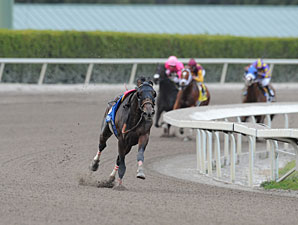
No one really knows why TBs run. Maybe this video shows a horse that loves to run. Maybe it shows a highly trained race horse that knows his usual and/or best distance. In either event--or both--it certainly showed a horse running without being flogged around the track.
Post script: The Bloodhorse website reports that the 5 year old caught a quarter coming out of the gate, causing the trip, but his trainer, while still observing him carefully, says the horse looks to be just fine otherwise.
UPDATE: Fort Larned's definitely OK. On June 15, 2013, The Blood Horse posted this: "Fort Larned Rolls to Easy Stephen Foster Win."
15 February 2010
03 February 2010
Who Are You? -- Part Three

FREDERICO GRISONE

Getting my energy up to discuss the Italian nobleman Frederico Grisone is difficult. First of all, his 1550 manual on horse training has yet to be translated into English although I've heard someone is working on it. I'm not sure I care since, to me, the bit to the left pretty much says it all. Grisone was a product of the Renaissance, a glorious time that glorified Man--specifically, the civilized Christian man doing God's work, i.e. dominating the world. Lesser creatures--be they New World natives or horses--look out!
Did I mention that horses often had teeth pulled to accommodate this type of bit, which I believe weighed up to five pounds or so.

Here is another example of Grisone's methods. This one shows how to teach a horse to lead. I wanted to use another illustration, one with a man poking a horse with a vicious cat that's been bound to the end of a long stick, but I can't find it right now. I suspect the less inventive illustration shown here is still vivid enough to make my point.
This Who Are You topic is not simply to condemn Grisone. I consider his horse torture reprehensible, but it is important to understand the underlying assumptions or beliefs that led to this type of approach.
Most horsemen are products of their time. A few rise above their day, but most do not. Perhaps Xenophon was just lucky and reflected the most enlightened atmosphere of ancient Greece. Perhaps Grisone was trapped by unfortunate elements of the Italian Renaissance and hence became a different type of trainer. As Sylvia Loch points out in Dressage: The Art of Classical Riding "sixteenth century Italian thinking was concerned as much with creating a grand illusion, as with seeking the truth. In drama, literature, art, and politics, rhetoric and spectacle abounded." That's the key to Grisone's methods and his time: "A grand illusion."
This Who Are You topic is not simply to condemn Grisone. I consider his horse torture reprehensible, but it is important to understand the underlying assumptions or beliefs that led to this type of approach.
Most horsemen are products of their time. A few rise above their day, but most do not. Perhaps Xenophon was just lucky and reflected the most enlightened atmosphere of ancient Greece. Perhaps Grisone was trapped by unfortunate elements of the Italian Renaissance and hence became a different type of trainer. As Sylvia Loch points out in Dressage: The Art of Classical Riding "sixteenth century Italian thinking was concerned as much with creating a grand illusion, as with seeking the truth. In drama, literature, art, and politics, rhetoric and spectacle abounded." That's the key to Grisone's methods and his time: "A grand illusion."
Unsurprisingly, Grisone was a contemporary of Nicolo Machiavelli, author of The Prince, the ultimate guide for leaders who want to retain power without having to be ethical or even particularly competent. The advice found in The Prince contends that the ends justify the means and that appearance trumps reality.
So, with Grisone the central issues of Who Are You arise. For horsemen perhaps we can simply ask this: Who was closer to the truth: Xenophon or Grisone? Which is better: democractic cooperation or totalitarian coercion?
I'd like to think the answer is simple, but it isn't. Both nature and nurture are at play. Our eras may pull us in one direction while our natural inclinations may pull us in another. Few of us think or intuit our way out of cultural givens. And in this case, Grisone succumbed to the standard assumptions of his culture and resorted to force, still an easy path for all too many people.
Let’s face it. Force can work IF the ends justify the means. Grisone solved disagreements between horse and rider not through the patient coaxing advised by Xenophon but through force, brutal force if necessary. For example, Grisone actually used something not unlike waterboarding on horses that feared crossing water, and anyone familiar with the work of psychologist Martin Seligman knows that relentless torture produces a sort of resigned compliance, “learned helplessness.”
This however leads to a more central issue of the governance of a horse: Do the ends indeed justify the means? Grisone's results were probably quite pleasing to the eyes of most. Only a few, undoubtedly those with both knowledge of and an innate sympathy for the horse, would see the underlying truth of Grisone's methods: a master-slave relationship.
The concept of master-slave then leads to a still deeper question. Isn’t that what all horse-rider relationships are? Is partnership possible with a lesser being? Are horses indeed lesser beings?
These are questions that people I deem real horseman answer in ways that most people, including many top riders, do not. Unfortunately, I still know people who heartily approve of the master-slave relationship between horse and rider. They apply draw reins and tie-downs and scoff at what’s now called natural horsemanship.
Reading Xenophon or just looking at the illustrations of Grisone's work should prompt a person to ask "Who am I? Do I seek CONTROL or COOPERATION?" These are central issues, not just for horsemen but for humanity. Who rules? How? And why?
Luckily for many generations of well-bred horses, Grisone's harsh methods quickly fell from favor--if not always from practice--at least at the upper levels of riding. But this leads to yet another question. Why then is Grisone often still referred to as the father of modern dressage?
From what I see, Grisone's importance lies not so much in what he wrote but that that he wrote SOMETHING. The printing press was invented in 1440 and a century later books were becoming much more common among the wealthy. So the printing press allowed Grisone's then fashionable method to spread rapidly. Indeed, his work was printed, reprinted, translated, and spread around much of Europe. As a writing instructor, I know that it's much easier to rewrite or even rip apart a text or one's own draft than it is to sit down and come up with original ideas while staring at a blank page.
From what I see, Grisone's importance lies not so much in what he wrote but that that he wrote SOMETHING. The printing press was invented in 1440 and a century later books were becoming much more common among the wealthy. So the printing press allowed Grisone's then fashionable method to spread rapidly. Indeed, his work was printed, reprinted, translated, and spread around much of Europe. As a writing instructor, I know that it's much easier to rewrite or even rip apart a text or one's own draft than it is to sit down and come up with original ideas while staring at a blank page.
What's true for reading and writing is also true for actual experience, and the Italian riding schools attracted Europe's aristocracy. So Grisone and his proteges gave other noble horsemen a framework to refine, retool, and rebel against. And they did. The ideas of others prompt us to respond. So we have to give Grisone credit for giving later, more humane horseman some starting points and a choice. In this case, most went back to Xenophon.
As proof of the evolution of horsemanship in Europe, here's an illustration from a fine German site showing the progressive changes to dressage bits that occurred as other horseman started reworking what Grisone began. Click on the picture to make it larger.

For still more information, there is a good discussion here: Federigo Grisone's Gli Ordini di Cavalcare
I'll post more on these later folks in Part 4, whenever I get around to it.
13 February 2009
A Rant Moved from My Farm Site to This Obscure Blog

"Lessons? Why? It's Just Like Sittin' in a Chair, Isn't It?"
Do you train people to ride horses or horses to be ridden? If so, how do you react when someone who has revealed an ignorance of ANY type or school of equitation says, "Can I ride your horse?"
Are you a casual rider with little or no formal schooling? Have you ever asked someone who lives and breathes horses, "Can I ride your horse?" Ever get an evasive or downright hostile response?
For the trainers, I suggest this line by long dead British horseman Colonel M. F. McTaggart: "I can guarantee that a horse is perfectly schooled. I cannot guarantee that anyone else can ride him."
For the casual riders, I suggest pondering another McTaggart gem: "Most people do not ride; they are conveyed."
The suggestion of LESSONS leaves many non-horsemen perplexed. While otherwise informed and intelligent, too many are totally unaware of the spectrum of aids and cues, theories and schools, all of which focus on how to get horses to do as we wish.
Many tell me they don't want lessons because they "just" want to ride my horses for "fun." As if I ride because it makes me miserable?
Typically, these folks just don't know that experienced riders use subtle aids and cues. Furthermore, they simply don't know what could happen if they were to make the wrong moves. For example, lean forward and clutch the reins on Lion. He's a model trail horse for those with a basic dressage or western seat, but he also raced for five years. Consider jockey position, then guess what he might do if someone went into a crouch and took a strong hold on the reins. He still LOVES to run and would probably hit 35 miles an hour within a couple of strides.
How could that lean and clutch happen? When something unexpected happens--for example when a horse spooks at a piece of plastic--instinct curls surprised, frightened people into the fetal position to protect their bellies. Unfortunately, this's a good way to invoke a runaway even on a horse that wasn't a professional racer. British riding instructor Heather Moffett refers to this reaction as the "fatal crouch."
Instincts do not make us good horsemen. For most of us, it's learning to override our instincts that makes us good horsemen. We learn to relax and stay with the moment and the movement. Easily said, not easily done.
Horses are prey animals and hence prone to sudden defensive movements. Hot-blooded horses like Arabs and Thoroughbreds can turn this into an art form. I still remember Razz suddenly lurching about fifty feet down a hill when I was on a trail ride. To my surprise, when I finally pulled myself upright--with my abs, NOT the reins--he immediately dropped back to a walk. He trusted my assessment that whatever frightened him didn't frighten me, so he relaxed.
So my conclusion is that most people who ask "Can I ride your horse?" have simply never ridden a hot or highly trained horse. In short, many think lessons are unnecessary because have "ridden" dull-sided, dead-mouthed automatons, the type found on dude strings. Others have been lucky enough to have been hauled around by someone's saintly packer. Or maybe they once put a quarter in the mechanical horse outside K-Mart.
For whatever reasons, all too many people think that riding a horse is simpler than riding a bicycle. After all, on a bicycle, a person has to pedal, while on a horse all a person has to do is sit there. It's just like sitting in a chair, right?
Uh, no. It's not. But how do you tell someone who's never really RIDDEN a horse?
I keep trying to find the perfect analogy. So far, this is the best I've found for the "Can I ride your horse" question:
"I've flown United, Southwest, and many other airlines. I love to fly. Can I take up your Cessna (or Stearman or Tomcat)? I mean, flying, how hard can it be?"
Imagine photo of ambulances and/or flaming wreckage here.
HERE ARE SOME RESPONSES I'VE GOTTEN AFTER SUGGESTING RIDING LESSONS.
Please bear in mind, most of these people have graduate degrees and otherwise show sense, intelligence, and reason.
"How hard can it be? You keep one leg on each side, kick to go, and pull to stop."
"Oh, I took some lessons when I was a teenager [thirty years ago], so I don't need any more."
"I assure you, I connect well with animals. We'll get along fine."
"When I was a kid, I rode every summer at my uncle's ranch. I know horses."
"The counselor at my Girl Scout camp [maybe twenty years ago] said I was a natural."
"I only want to go on a little trail ride. That's not asking much, is it?"
"Jay Leno said the idea of riding lessons was ridiculous." [Leno did. I watched the program.]
SOMETIMES PEOPLE GET IT
One of these "How hard can it be?" people visted me on the weekend of the Rocky Mountain Dressage Championships. After arriving, she went with me to view the upper level championships. I was sighing at the level of expertise, but she, knowing nothing, was bored. I mean, circles and some funny slow trotting, how hard can it be?
The next morning, I put her on a longe horse. Within minutes, she was gasping at the difficulty of balance and timing at the trot. That night, we went back to the dressage championships where the lower levels were being judged. After one longe session, my visitor was clutching my arm, saying, "How are they doing that?! That's IMPOSSIBLE!"
I facetiously told her it was done with mirrors. Inside joke. Horses indeed mirror their owners and riders, but this is beyond the scope of this rant.
MY WORST EXPERIENCE AS A RIDING INSTRUCTOR
In the early 1980s, shortly after I first started taking on students who weren't friends or neighbors, I got a phone call from a mother who wanted riding lessons for her daughter. Her daughter, she said, was "an expert western rider" who now wanted to learn English as well.
I probably should have been concerned when the woman showed up with a seventeen year old girl, not a twelve year old, but I wasn't. I prepared my longe horse and from the ground did a basic safety orientation with the young woman. Everything seemed OK.
Then she mounted the horse. Within seconds, I could see she was a total beginner and shortened the longe rein. The poor girl looked fit enough but was incredibly clumsy even with the horse at a slow walk. With the mother hovering at the fence, I asked the girl where she'd ridden. She said she'd had two whole weeks at a dude camp a year before.
I gulped and continued a beginner-beginner lesson. After a few minutes, I thought things were going a bit better, so I asked the girl to grasp the neck rope and try to balance in two-point/galloping position. With my horse barely moving, the girl lost her balance and fell backward, crashing onto his croup, causing him to flinch forward about two feet. The girl slid off his rear and landed hard on her back.
Luckily, she was not injured. But her mother started ranting that this was my fault because her daughter was "an expert western rider"--she actually said this again--and if she "had the reins, this wouldn't have happened." I thought to myself that if she'd had reins, the horse might well have gone over on her even though he was bitless, but merely said that I didn't think I was a good fit as a teacher for her daughter.
I breathed a huge sigh of relief when they pulled out of the driveway, and I went into the house to make a list of things to ask potential students in the future.
A DELIGHTFUL SUCCESS
Around the same time that the "expert western rider" showed up, a young man came down our lane on a borrowed horse, a Half Arab gelding belonging to my first student. (The student's brother had without permission loaned his friend her horse, but that's another story.) This young man was extremely frustrated because he couldn't get the gelding to go where he wanted. Knowing the pony had become utterly pushbutton, I asked him what cues he was using. The young man looked at me and said, "Cues?"
I explained the basic principles and he looked like he'd been hit by lightning. He'd ridden broncs for fun in high school and had wrangled at dude ranches. But he still had no idea that horses could be TRAINED to respond to subtleties.
I got on the pony, cantered a figure-eight with a simple change, halted, and backed a couple of steps--all on a loose rein. At this point, the young man wanted to know HOW I was doing this.
All instructors should have a student like this at least once. He was incredibly athletic. As a former bronc rider, sitting a horse was no problem at all. He just wanted the basics of equitation and some theory, so he took only about six lessons from me, but by then he looked better than many riders ever do.
But that's not the best part of this story.
Quite a while later, I ran into him again, and he told me he and a friend had visited the ranch of a Paso Fino breeder and he'd asked--you guessed it--"Can I ride one of your horses?"
When the breeder said no, he responded with "Oh, I understand. Your horses probably work off totally different cues than the ones I know." Hearing the magic words, she smiled, told him her cues, and put him up on one of her horses. He said he had a wonderful ride.
A wonderful ride. On a horse trained in a different school. This is still one of the best things I've ever heard.
Then there are those of us who have worked at riding and realize we are still limited. A long time ago, I had a delightful conversation with a gaited horse trainer. Since I knew little about training gaited horses and he knew little about dressage theory, we ended up explaining our systems.
When I explained how I used my legs, seat, shoulders, and abs to stop a horse, he said, "Do that on one of mine, and it'll bolt."
When he explained his method of using his hands, I said, "Do that on one of mine, and you'll probably have ears in your teeth."
He ended up giving me a brief lesson on one of his horses. I thoroughly enjoyed it, but I fretted the whole time, trying to keep my legs away and my hands in a position they'd never occupied before. The horse was beautifully schooled for saddle seat. I wasn't.
In short, there's no one "right" way to signal a horse to do something. Aids--natural pressures from hand, leg, seat or artificial pressures from whip and spurs--inspire universal responses, but these can be blunted or extinguished when a rider fails to reward the the horse. Cues, the conditioned responses, can be anything, but they need to be understood by both horse and rider. For example, I love telling my students about the highly individualized anti-theft cues installed by the Bedouins. For example, an individual mare might be conditioned to put forth her best speed only when the rider touched her right ear and yelled, "Allah be praised!!"
So my recommendation to anyone who wants to ride someone else's horse is to describe the type riding you've done and and then follow the lead of that young bronc rider and weave "What cues do you use?" into your request to ride.
If the horse owner is a good horseman, this question shows a level of awareness that could start a dialog that'll eventually get you on a horse. On the other hand, it might be a good idea to back away slowly if the horse owner says, "Cues?" If there's anything more worrisome than an untrained rider, it's an untrained horse owner.
01 February 2009
Horse Play
Once again, here's my purebred Arab gelding, the most curious, playful horse I've ever owned.
Several years ago, I put a hula hoop on the ground and backed up to film him. By the time I turned on the camera, he was already in action. Those sounds? Horse teeth crunching plastic. That's why this's three seconds long.
13 January 2009
Price Downturns -- Not Just for US Housing
Here's one of the lead stories at TheBloodHorse.com today: "Keeneland Opening Average Plummets 45.9%":
The results were grim, but not surprising, as Keeneland opened its January horses of all ages sale in Lexington during a time of worldwide economic downturns. The gross revenue Jan. 12 plummeted 44% from the auction’s first session in 2008 while the average price dropped 45.9%. The median price suffered the most damage, falling 50.9%.Not surprising, indeed. But this sale shows the extent of the downturn since this is an upper-end racing stock sale:
The 202 horses that sold grossed $11,945,900 and averaged $59,138. The median was $27,000. Last year, 195 horses were sold during the first session for a gross of $21,325,900 and an average of $109,364. The median was $55,000.So this is not where mom and dad go to buy a nice show hunter prospect for little Emily.
However, with high-end warmblood prices still holding up fairly well, I'm actually hearing some show people are starting to venture into the mid-range TB sales looking for show horse prospects.
And many sites, such as TheHorse.com, now have lists of free Thoroughbreds.
Free horse--an oxymoron if there ever was one.
I need to get one of those T-shirts with this text:
I do NOT need another horse.
I do NOT need another horse.
I do NOT need another horse.
I do NOT need another horse.
Subscribe to:
Posts (Atom)
