
Showing posts with label Horse Abuse. Show all posts
Showing posts with label Horse Abuse. Show all posts
21 May 2014
Reblog: Starstone -- Photos of How Show Horses Suffer
This is a reblog of the Stonestone entry of 21 May 2014. It contains vivid documentation of how horses in the show ring suffer.
http://starstonestenfalk.wordpress.com/2014/05/21/jbk-festival-torture-like-in-the-dark-ages-anything-goes-in-the-equestrian-sport/


15 June 2013
The Answer to Abuse: Censorship
In the United States right now, there's a move in many states to stop people from going undercover to attempt to find animal abuse in factory farms or in gaited horse training and so on. It's an odd twist at best. Instead of stopping animal abuse, just stop people from showing the world animal abuse.
Unfortunately, the United States is not alone. In Europe, those who have been documenting the use of rollkur, a severe dressage training method that overbends a horse, in warm-up rings have been met with the same sort of reaction.
Here's an example of rollkur:

This is NOT how horses hold their heads. This is not what will be required in the show ring. This is--oh, just read Tug of War by German veterinarian and certified trainer Dr. Gerd Heuschmann. He damns the technique quite effectively.
But the people who train this way turn out utterly submissive horses that WIN, and that means it's not abuse, right? Winning is everything after all, so, as with the soring of Tennessee walking horses, the answer is not to ban the winning technique, the answer is to attempt to stop people from revealing the dirty little secrets behind the winning.
Here's an article discussing the situation: "If the Shoe Fits"
Here's another photo of non-existent warm-up ring horse abuse:

But you won't be seeing many more of these photos if the trend continues of allowing the abuse to continue while banning attempts to expose it. In the current twisted world of dressage, abuse wins--on many levels.
14 March 2013
Fort Larned's "Winning" Run
Much controversy surrounds why Thoroughbreds run. Of late, I've seen considerable discussion of whip use and condemnation of horse racing in general. Fort Larned's riderless "win" in the Gulfstream Handicap ought to provide another aspect for discussion, but, considering the mentality of most people who comment on the Internet, I suspect it won't.
In fact, I should stop reading the comments under horse-related articles on the Web. The general level of romanticism and irrationality is bad enough, but the overall ignorance causes me to froth at the mouth.
What's infuriated me lately are a number of remarks complaining about whip use, saying that jockeys constantly beat their horses during a race and that race horses only run because they are beaten.
I complain about whip use too, but I do so because a growing body of research indicates whipping is basically pointless, futile, and hence cruel. Some countries are ahead of us in limiting whipping. For example, many years back, Sweden ruled that a jockey must hold onto the mane when using the whip and is limited to three whacks a race. Some US tracks already allow only padded bats with large, doubled, triangular slappers--literally slapsticks--which create more noise than pain.
Even without regulation, the races I've seen of late don't seem to have as much whipping as they did even a few years ago and certainly much less than occurred during some 18th and 19th Century races when horse beating was generally accepted as necessary. In comparison, today's best jockeys restrain their whip use. Of course, like the rest of us, not all jockeys have great talent or good sense, so stricter rules should pass.
However, I suspect that self-selection reduces whip use. For many trainers and owners it's become clearer that jockeys who use the whip too much lose many more races than they win and, worse yet, extensive whipping merely desensitizes the horses to the pain, making further whip use pointless.
As to whether race horses like to run, I know my off the track Thoroughbred sure did. (My avatar shows him wafting around my fields.) Upon being turned out for breakfast, he swept around our twenty acres, covering at least a mile before settling down to graze. Watching him was a thrill for me.
Watching the riderless Fort Larned sweep by his rivals in the 2013 Gulfstream Park Handicap (Grade II) was a comparable thrill. The favorite, he stumbled badly at the start, lost his jockey, then blew by the rest of the field and disappeared off screen. At 1:45 in the video, there's a glimpse of him after the finish line. He's clearly pulling himself up after "winning" by a distance comparable to that of Secretariat in the Belmont.
Bloodhorse put up this still photo of Fort Larned, close to the rail, ears swept back in concentration, doing his job despite the lack of human guidance. One thing's for sure. No jockey used a whip on him that day, and yet Fort Larned ran a fine race.
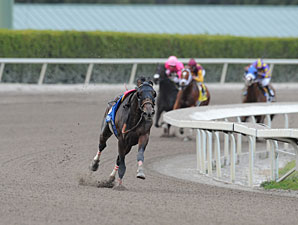
No one really knows why TBs run. Maybe this video shows a horse that loves to run. Maybe it shows a highly trained race horse that knows his usual and/or best distance. In either event--or both--it certainly showed a horse running without being flogged around the track.
Post script: The Bloodhorse website reports that the 5 year old caught a quarter coming out of the gate, causing the trip, but his trainer, while still observing him carefully, says the horse looks to be just fine otherwise.
UPDATE: Fort Larned's definitely OK. On June 15, 2013, The Blood Horse posted this: "Fort Larned Rolls to Easy Stephen Foster Win."
11 March 2013
Hay--The Last Straw
Over the last eight years or so, horses have suffered more and more from the ripple effects of the economy. Now with growing evidence climate change in the form of persistent droughts, the soaring cost of hay and grain adds to the dilemma.
Obviously, the ideal is to shift horses to new homes, but that's harder and harder to do. My neighbor, a well known animal cruelty expert, told me how dire the horse rescue situation has become--full to overflowing, long waiting lists. It looks like the situation is not getting any better as time passes.
Here's the latest story: "13 Paso Fino Horses Need Homes."
The bit about breeding for the agricultural exemption raised a red flag with me, but this owner tried to surrender them, something a number of other owners have failed to do, and a serious illness can push anyone over the edge. It's sad, but both marginal owners and many formerly flush horse owners look to be totally ill prepared for bad times, and their horses are paying the price.
In the last year or two, the more exotic breeds began to show up in the news. In the past year or two Lusitanos and Arabians hit the headlines. What next? Friesians?
I suspect the situation's only going to get worse. Some forty or fifty thousand ferals warehoused by the BLM, a glut of horses bred by hobby breeders, the usual flood of failed race horses, all this points towards a horse holocaust as the middle class shrinks and feed prices edge higher and higher.
UPDATE: The same economic problems afflict Ireland, England, and other European countries. Horror stories abound. For example, a 7 year old Irish Sport Horse was sent to a rather well known rider to be offered for sale. Here's how he was returned to the owner:

Since I recently purchased an Andalusian gelding that I adore, this 12 Mar. 2013 story brought on a shudder: "Thousands of Spain's Horses Head for the Slaughterhouse As Economic Crisis Results in Abandonment."
Of course, I already knew how bad things were there. Just a few days before this article appeared, English trainer Heather Moffett posted a photo of a highly trained Alter Real stallion on her Facebook page with a plea for someone to grab the horse. Located in Portugal or Spain, the stallion was being offered for 3000 Euros, a fraction of what a stallion of his quality would have gone for a few years back.
People screw up and animals suffer.
20 December 2012
The Ever Shrinking Hay Supply
This morning I found among the many news articles on horse abuse one from Minnesota giving a reason why hay prices skyrocketed:
A ton of hay costs $220 -- nearly double the $120 it cost a year ago, said Krishona Martinson, equine extension specialist for the University of Minnesota. The rising costs are attributed to drought and farmers' reluctance to grow hay, which cannot be insured through the U.S. Department of Agriculture. Growing soybeans and corn is less expensive and less of a risk, Martinson said.My hay supplier here in Colorado told me many of his resources shifted to corn or other crops last year. Considering the drought, I wondered why. Crop insurance. That explains much.
The extreme drought in Colorado also explains why $220 a ton sounds cheap to us. Local hay supplies withered. Wyoming hay was over $300 a ton, and top quality hay much more than that. I can vouch for that.
11 November 2012
"Wild Horse Buyer under Investigation for Breaking State Law"
Tom Davis' name has been coming up a lot in horse circles of late. With any luck at all, it'll soon be coming up in court. The bare facts revealed so far indicate the corruption goes way beyond Davis too.
For example, here's one paragraph from the November 11, 2012, Colorado Spring Gazette article "Wild Horse Buyer under Investigation for Breaking State Law":
Davis, 64, a livestock hauler and proponent of the horse meat industry who lives in La Jara, 15 miles southwest of Alamosa, has purchased more than 1,700 wild horses from the federal Bureau of Land Management since 2008 — roughly 70 percent of all horses sold by the agency.Could anyone of normal intelligence read this article and think Davis found "good homes" for all these horses?
Worse yet, the BLM--or at least some BLM employees--were deeply involved in this. As the director of Wild Horse Education, a Nevada-based advocacy group, Laura Leigh said,
Let's get real. There is no way the BLM could think someone was buying that many unadoptable horses for anything but slaughter. The people who sold those horses are just as culpable. This is a breach of public trust and there needs to be some accountability.Here's the contact information for Colorado’s 12th Judicial District Attorney, David Mahoney:
Alamosa County Office
426 San Juan Ave.
Alamosa, CO 81101
(719)589-3691; (719)589-2734 fxFeel free to give his office a call. In fact, put his number on speed dial. Call early, call often. Then call local stables, horse owners, and the media. I want more coverage of this mess.
Flagrant law breaking and corruption don't sit well with me, especially when Mexican slaughter houses are involved.
For what it's worth, I'll add that I'm not utterly opposed to horse slaughter. I am however absolutely opposed to inhumane horse slaughter and inhumane horse transport, both of which flavor this story of contempt for horses and laws.
UPDATE: June 18, 2013 -- "DA Won’t Prosecute Wild Horse Investor"
Investor?!
08 April 2012
The Chariot Metaphor
For months now I haven't posted on this blog. Blame Plato's Phaedrus. My ability to blog about horses was blocked by an obsession with Plato's chariot metaphor.
Perhaps George Eliot, author of Middlemarch, said it best when she wrote, "For all of us, grave or light, get our thoughts entangled in metaphors, and act fatally on the strength of them." That was my fear when I began stewing about the influence of long dead Plato's chariot metaphor on the once live horses of the Western past and the still live horses of today.
The obsession was starting when I posted "A Metaphor That Actually Works" back on 19 Oct. 2011. Shortly before that, I ran into an online discussion rippling with mentions of Plato's chariot metaphor. As far as I could tell, absolutely everyone posting about chariot driving lacked basic knowledge of the horse and horsemanship. Just like Plato. This of course didn't stop him or them from using horse imagery. Some of the responses in this discussion left me scratching my head because I expect metaphor to have SOME basis in reality.
So I became confused, and then I became angry. For example, one person had a pair of runaway chariot horses going in circles. That actual horses bolt in circles only when confined to a round pen was not of any interest to them. My pointing out the problems with misleading metaphor made me about as many friends as pointing out their lack of knowledge of horsemanship. This site has a highly educated set of followers, and, when not talking about horses or forming metaphors, their educations generally serve them well. Finally, I became sad because they really didn't see anything wrong with Plato's metaphor, and, if they don't, who will?
Horses are now an exotic topic for most, but, nevertheless, I worry about the actual metaphor and about actual horsemanship. Most well-educated people and a good many not-so-well-educated people know the general contours of Plato's chariot metaphor. It's quite like, but a bit more accessible than Freud's id-ego-superego construct. Basically, the rational part of the mind is the driver of the chariot and the pair of horses represents the base and the noble aspects of our nature. If one hasn't actually read what Plato wrote, the chariot metaphor is actually quite good.
Horses are now an exotic topic for most, but, nevertheless, I worry about the actual metaphor and about actual horsemanship. Most well-educated people and a good many not-so-well-educated people know the general contours of Plato's chariot metaphor. It's quite like, but a bit more accessible than Freud's id-ego-superego construct. Basically, the rational part of the mind is the driver of the chariot and the pair of horses represents the base and the noble aspects of our nature. If one hasn't actually read what Plato wrote, the chariot metaphor is actually quite good.
Unfortunately, I've read Phaedrus. Here's the scene where the "rational" charioteer "trains" the "bad" horse to restrain its sexual impulses:
As I said at the beginning of this tale, I divided each soul into three-two horses and a charioteer; and one of the horses was good and the other bad: the division may remain, but I have not yet explained in what the goodness or badness of either consists, and to that I will proceed. The right-hand horse is upright and cleanly made; he has a lofty neck and an aquiline nose; his colour is white, and his eyes dark; he is a lover of honour and modesty and temperance, and the follower of true glory; he needs no touch of the whip, but is guided by word and admonition only. The other is a crooked lumbering animal, put together anyhow; he has a short thick neck; he is flat-faced and of a dark colour, with grey eyes and blood-red complexion; the mate of insolence and pride, shag-eared and deaf, hardly yielding to whip and spur. Now when the charioteer beholds the vision of love, and has his whole soul warmed through sense, and is full of the prickings and ticklings of desire, the obedient steed, then as always under the government of shame, refrains from leaping on the beloved; but the other, heedless of the pricks and of the blows of the whip, plunges and runs away, giving all manner of trouble to his companion and the charioteer . . . . [The charioteer] falls backwards in adoration, and by his fall is compelled to pull back the reins with such violence as to bring both the steeds on their haunches, the one willing and unresisting, the unruly one very unwilling; and when they have gone back a little, the one is overcome with shame and wonder, and his whole soul is bathed in perspiration; the other, when the pain is over which the bridle and the fall had given him, having with difficulty taken breath, is full of wrath and reproaches, which he heaps upon the charioteer and his fellow-steed, for want of courage and manhood, declaring that they have been false to their agreement and guilty of desertion . . . . And when they are near he stoops his head and puts up his tail, and takes the bit in his teeth. and pulls shamelessly. Then the charioteer is. worse off than ever; he falls back like a racer at the barrier, and with a still more violent wrench drags the bit out of the teeth of the wild steed and covers his abusive tongue and-jaws with blood, and forces his legs and haunches to the ground and punishes him sorely. And when this has happened several times and the villain has ceased from his wanton way, he is tamed and humbled, and follows the will of the charioteer, and when he sees the beautiful one he is ready to die of fear. And from that time forward the soul of the lover follows the beloved in modesty and holy fear.
See also: “An Unfortunate Historical Remnant” to see a typical Greek bit
I left in my highlighting, but most horsemen won't need it. "Holy fear," my ass and horses as well. This passage leaves me sputtering, and that's without getting into the racist aspects of the good white horse and the bad dark horse.
Is it clear to everyone from reading the excerpt that Plato, great philosopher that he was, lacked a grasp of basic horsemanship? Given what I read, that "dark" horse may have suffered such a mangled tongue that he starved to death. But he learned his lesson, didn't he? I'll bet kids could ride him after he was properly beaten. OK, OK, I'm starting to steam again.
In fairness, I should note that upper class Greeks did not trouble themselves with mundane tasks such as horse training. That was work for lesser men. Still, I find Plato's charioteer far from rational. Anyone seeing that sort of behavior today would most likely be on the phone to the SPCA or the police. Savage abuse may well have been common in Plato's day, but horses were expensive, and the "rational" charioteer may well have fatally injured one, albeit a "dark" one.
It's difficult to gauge the actual level of Greek horsemanship, but Plato [circa 428 BCE - 347 BCE] and Xenophon [circa 430 BCE-355 BCE] were contemporaries, so truly rational horsemanship was known by at least a few literate Greeks.
It's difficult to gauge the actual level of Greek horsemanship, but Plato [circa 428 BCE - 347 BCE] and Xenophon [circa 430 BCE-355 BCE] were contemporaries, so truly rational horsemanship was known by at least a few literate Greeks.
The real question is what was Plato's influence on Western horsemanship. If it had any, the influence would have affected the upper classes. Reading this snippet from Phaedrus, I wondered if Grisone had read it as well. That was about the time that reading Greek classics came back into Western civilization. Later on, I can picture some British public school lad thrashing his horse and justifying it by quoting Plato--in the original Greek, of course. How much damage has this metaphor done to actual horses? Some? None? A little? A lot?
I suspect several PhD theses lurk in the equine aspects of Phaedrus and its tendrils. I leave it to some other English major/horse trainer/psychologist/historian to pursue. Just counting the misconceptions and atrocities in this passage should be enough to keep some real horsemen awake at night.
For now, I just hope those who use metaphor will stick to things they understand at least somewhat. Most of us today understand horses about as well as Plato did. As philosophy professor John Searle said, "[W]e're constantly tempted to use the latest technology as a model for trying to understand . . . . Freud often compared the brain to hydraulic and electromagnetic systems. Leibniz compared it to a mill, and now, obviously, the metaphor is the digital computer." I hope those who aren't horsemen stick to the computer. Computers don't have legs and tongues, and "smart" as they might be, they lack the ability to sense pain.
For now, I just hope those who use metaphor will stick to things they understand at least somewhat. Most of us today understand horses about as well as Plato did. As philosophy professor John Searle said, "[W]e're constantly tempted to use the latest technology as a model for trying to understand . . . . Freud often compared the brain to hydraulic and electromagnetic systems. Leibniz compared it to a mill, and now, obviously, the metaphor is the digital computer." I hope those who aren't horsemen stick to the computer. Computers don't have legs and tongues, and "smart" as they might be, they lack the ability to sense pain.
Subscribe to:
Posts (Atom)
