
Showing posts with label horse racing. Show all posts
Showing posts with label horse racing. Show all posts
13 February 2014
Another Tiny Bit of Good Racing News
I've long appreciated John Shirreff's training methods and general attitude toward the race horses in his stable, so this was good but unexpected news:
"Eblouissante Benefits from Dressage Training"


01 February 2014
"St Nicholas Abbey's Brave Battle"
Steve Haskin's blog at Bloodhorse.com detailed the struggles of St. Nicholas Abbey. As I'd suspected, the horse was utterly kind and possessed of a high pain tolerance, among a species known for high pain tolerances. I'm not a huge racing fan, but this horse's expression in a couple of still photos captured my attention so I've followed the story, hoping for a miracle. Alas, from Haskin's article, the horse's stoicism--we'd say valor--apparently contributed to his ultimate demise.
St Nicholas Abbey's Brave Battle
03 August 2013
On the Upper End of Horse Racing
When race geldings like Monzante wear out, their end is usually dismal. On the other hand, when a well-bred and highly successful colt or stallion injures itself, the best side of horse racing comes out. St Nicholas Abbey, Irish winner of £4,954,590, is one such horse. He not only broke down, but after his surgery on the broken leg, he suffered an extremely serious case of colic and has been on IV feeding since then. His potential as a breeding horse means the care he's receiving has been top notch as this video shows:
St Nicholas Abbey: The Road to Recovery
Of course, there's no assurance St. Nicolas Abbey will recover, but few people will ever get the care this horse is getting--not even people like Steve Jobs.21 July 2013
Here's Why I Am Ambivalent about Horse Racing
More often than not, race horse geldings come to a sad, early end. Without the possibility of a second career in the breeding shed, even the best bred geldings not fast enough to win typically end up at killer sales before they turn three.
A few geldings that do win and win sometimes fare better, but only a handful, like my beloved Life Goes On, retire sound and go on to lives as pleasure or show horses. My Li-On started 42 times before being retired at 8. When his speed faded, his owner donated him to ReRun and I adopted him. Unfortunately, this is rare. Only a few veteran geldings like him, horses with good movement and good temperaments find civilian homes.
Most war horse runners suffer the fate of Monzante, a former Grade 1 stakes winner. Monzante died today, euthanized after failing to finish a $4,000 claiming race at a backwater track with a not so good reputation in a business with an overall not so good reputation.
Monzanto was 9 years old and had been, in a familiar pattern, dropping down to cheaper and cheaper races over the years until he his owners had squeezed the final bit of profit out of a failing horse and an obscure headline like this is his epitaph:
"MONZANTE, FORMER EDDIE READ WINNER, BREAKS DOWN IN $4,000 CLAIMING RACE"
As Ray Paulick says in this article, "Compassion, common sense, and decency by any of Monzante’s previous owners or trainers would have stopped the horse’s descent to the lowest rung on the racing ladder, where the endings are seldom good."
Some breeders and trainers attach notes to the registry papers of horses they sell or lose in claiming races, asking that they be contacted when the horse's racing career ended, but there's no assurance that anyone will read those notes. So, as would be expected, low end tracks, like low end rodeos, produce more incidents like this.
The worst race tracks I know of are the county fair tracks. There, only occasional human intervention saves horses like Monzante. I remember reading of one such case a few years ago. The load of sacrificial Thoroughbreds arrived and someone actually looked at their papers, his eyes popping when he realized the old campaigner who hobbled off the van had once been a Grade 1 winner. He got on the phone and a rescue group saved that old gelding.
The Jockey Club is aware of the fate of the slow and the lamed and some tracks now bar sales to kill buyers, but much more needs to be done to at least provide humane euthanasia for those former and failed race horses that aren't suitable for second careers. The idea of setting aside one percent of all purse money to take care of these old guys is an excellent idea.
That however would mean a tad less money for those racing, and, as the details of the Equibase chart show, had Monzante staggered to a second or third place finish, he could have won a grand or so. After all, race horses are just money making tools, right? A grand's a grand, especially for those at the bottom of the racing ladder.
Casino tracks present another sort of problem. I've seen purses so large that owners would be tempted to enter their unfit, unsound, and/or doped up horses. To their credit, at least one track--can't remember which--has changed the claiming rules so that should a horse break down during the race the claim is voided. That staves off a bit of temptation, I hope.
That however would mean a tad less money for those racing, and, as the details of the Equibase chart show, had Monzante staggered to a second or third place finish, he could have won a grand or so. After all, race horses are just money making tools, right? A grand's a grand, especially for those at the bottom of the racing ladder.
Casino tracks present another sort of problem. I've seen purses so large that owners would be tempted to enter their unfit, unsound, and/or doped up horses. To their credit, at least one track--can't remember which--has changed the claiming rules so that should a horse break down during the race the claim is voided. That staves off a bit of temptation, I hope.
Still, on days like today, I hate horse racing.
--------------------------------
UPDATES:
Evangeline Downs, a casino track, is not accredited by the National Thoroughbred Racing Association.
"NTRA Issues Statement on Monzante's Death'
From the Daily Racing Form: "Evangeline Downs: Monzante's Death Leads to Investigation"
This too from the DRF: "Monzante Deemed 'Salvageable' before Being Put Down, Regulator Says"
Now that last one will undoubtedly spark discussion. At least the owner, for whatever reasons, had the gelding euthanized. I still remember reading of one TB in California. His trainer sent him to a killer auction on three legs, the fourth one dangling with a fresh break.
July 24, 2013: "Trainer: Monzante Euthanized Due to Injuries"
July 25, 2013: "LA Plans No Further Action in Monzante Case"
This too from the DRF: "Monzante Deemed 'Salvageable' before Being Put Down, Regulator Says"
Now that last one will undoubtedly spark discussion. At least the owner, for whatever reasons, had the gelding euthanized. I still remember reading of one TB in California. His trainer sent him to a killer auction on three legs, the fourth one dangling with a fresh break.
July 24, 2013: "Trainer: Monzante Euthanized Due to Injuries"
July 25, 2013: "LA Plans No Further Action in Monzante Case"
08 July 2013
Ruffian
Below is the September 2, 1974 issue of The Blood Horse. On the cover, the great filly Ruffian. She died July 7, 1975, after breaking down in a match race against Kentucky Derby winner Foolish Pleasure.
I remember feeling a chill when I saw this cover. I immediately showed it to my husband and said, "Doesn't this look like a sesamoid fracture waiting to happen?" The photo troubled me so much, I kept this magazine, the only one I saved from my one year subscription. I kept looking at those incredibly long pasterns, those delicate legs, delicate even by race horse standards.

Ruffian came by her bones honestly if not fortunately. Her sire, the infamously fragile Reviewer broke down three times during his racing days. Even retirement didn't save him. Only 11, he broke his left hind leg while in his paddock and had to be put down. Ruffian's dam Shenanigans was a daughter of Native Dancer, a wildly superior race horse, but also a horse associated with unsoundness.
Given all this, I was quite worried when the gates flew open for the match race. The details of the attempts to save her still trouble me almost as much as watching this short, non-graphic clip of her breakdown.
About the best thing I can say about the Monday she died was that no one I worked with was surprised. I'd told my co-workers about the difficulty of repairing broken bones in equines before this race.
I'm not against racing. A few accidents will happen, but American race horse breeding is equicidal. We breed horses too delicate to exist with other horses too delicate to exist in order to get even faster horses too delicate to exist. Ruffian was one example. Eight Belles was another. That sweet filly broke both ankles while pulling up after a second place finish in the 2008 Kentucky Derby. Unsurprisingly, Eight Belles pedigree was festooned with the name Raise a Native, he by Native Dancer.
Yes, American race horses fly--but too often they fly apart.
23 May 2013
15 April 2013
Xavier Perez's Wild Ride
I've read lots of articles offering opinions and statistics on which professional sport has the best conditioned athletes. Several of these didn't even consider jockeys. Those that did usually put them at or near the top. Race riders need stamina, balance, strength, coordination, and they need all those packed into a spare body.
Good jockeys need more than physical condition though. Guts. Persistence. Timing. Much more. In the video of the last race at Pimlico on April 13, 2013, Xavier Perez quite possibly shows them all.
I never thought I'd see a 21st Century jockey recover from two bolts and then nearly win a race sitting like a 19th Century rider.
(The video appears at the bottom of the article, but here's a direct link to the race on YouTube: http://www.youtube.com/watch?feature=player_embedded&v=FbH3N5VJzBE )
UPDATE: On April 16, Britain's Guardian newspaper posted a minute long clip of this race: "Spicer Cub: Unluckiest Horse Racing Loser Ever? – video." The title suggests someone didn't know much about horses. Luck had little to do with this.
And here's another head-on view of the stretch: "Horse Runs Wrong Way on Homestretch, Almost Wins Race."
14 March 2013
Fort Larned's "Winning" Run
Much controversy surrounds why Thoroughbreds run. Of late, I've seen considerable discussion of whip use and condemnation of horse racing in general. Fort Larned's riderless "win" in the Gulfstream Handicap ought to provide another aspect for discussion, but, considering the mentality of most people who comment on the Internet, I suspect it won't.
In fact, I should stop reading the comments under horse-related articles on the Web. The general level of romanticism and irrationality is bad enough, but the overall ignorance causes me to froth at the mouth.
What's infuriated me lately are a number of remarks complaining about whip use, saying that jockeys constantly beat their horses during a race and that race horses only run because they are beaten.
I complain about whip use too, but I do so because a growing body of research indicates whipping is basically pointless, futile, and hence cruel. Some countries are ahead of us in limiting whipping. For example, many years back, Sweden ruled that a jockey must hold onto the mane when using the whip and is limited to three whacks a race. Some US tracks already allow only padded bats with large, doubled, triangular slappers--literally slapsticks--which create more noise than pain.
Even without regulation, the races I've seen of late don't seem to have as much whipping as they did even a few years ago and certainly much less than occurred during some 18th and 19th Century races when horse beating was generally accepted as necessary. In comparison, today's best jockeys restrain their whip use. Of course, like the rest of us, not all jockeys have great talent or good sense, so stricter rules should pass.
However, I suspect that self-selection reduces whip use. For many trainers and owners it's become clearer that jockeys who use the whip too much lose many more races than they win and, worse yet, extensive whipping merely desensitizes the horses to the pain, making further whip use pointless.
As to whether race horses like to run, I know my off the track Thoroughbred sure did. (My avatar shows him wafting around my fields.) Upon being turned out for breakfast, he swept around our twenty acres, covering at least a mile before settling down to graze. Watching him was a thrill for me.
Watching the riderless Fort Larned sweep by his rivals in the 2013 Gulfstream Park Handicap (Grade II) was a comparable thrill. The favorite, he stumbled badly at the start, lost his jockey, then blew by the rest of the field and disappeared off screen. At 1:45 in the video, there's a glimpse of him after the finish line. He's clearly pulling himself up after "winning" by a distance comparable to that of Secretariat in the Belmont.
Bloodhorse put up this still photo of Fort Larned, close to the rail, ears swept back in concentration, doing his job despite the lack of human guidance. One thing's for sure. No jockey used a whip on him that day, and yet Fort Larned ran a fine race.
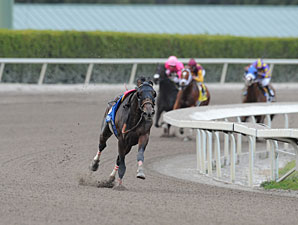
No one really knows why TBs run. Maybe this video shows a horse that loves to run. Maybe it shows a highly trained race horse that knows his usual and/or best distance. In either event--or both--it certainly showed a horse running without being flogged around the track.
Post script: The Bloodhorse website reports that the 5 year old caught a quarter coming out of the gate, causing the trip, but his trainer, while still observing him carefully, says the horse looks to be just fine otherwise.
UPDATE: Fort Larned's definitely OK. On June 15, 2013, The Blood Horse posted this: "Fort Larned Rolls to Easy Stephen Foster Win."
09 January 2013
Horse Auctions
Most horse auctions in the United States depress me since they send old, injured, and unwanted horses off to sad fates in foreign countries. However, at the other end of the spectrum, auctions of elite Thoroughbreds bring out buyers securely in the ranks of the super-rich.
Here's one example:
17 October 2012
A Clear Statement of the Obvious
Dr. Larry Bramlage, one of the most prominent equine veterinarians in the world, states the obvious in an article in today's Blood Horse:
Bramlage: Rest Needed to Keep Horses Sound
Not only do horses need rest, they need maturity and structural soundness. Too many American TBs are running on artificial stimulants and pain killers. It's obscene.
I wish the United States had the stringent rules against drugs that Germany has. As a result of their rules, a good many of their horses are actually bred for soundness.
Alas, as Bramlage notes, today's American Thoroughbreds are not.
Subscribe to:
Posts (Atom)
