19 July 2011
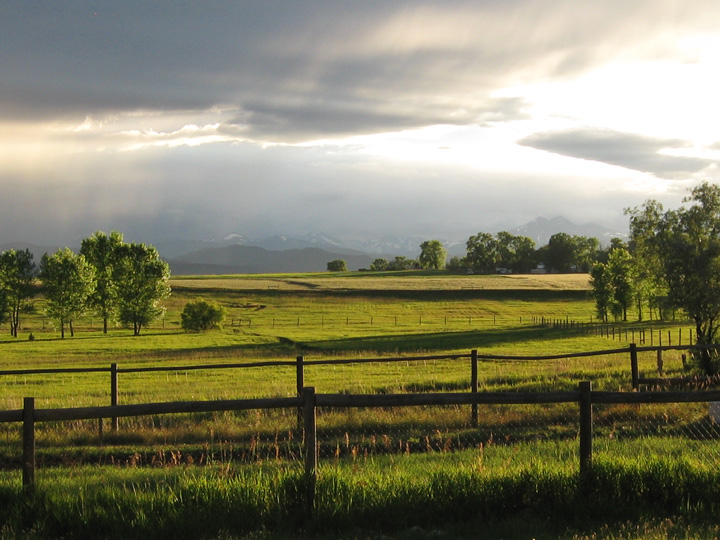
Our Fields on July 9, 2011
Here's a photo that may explain why I post so rarely during summer. We weed twenty acres by hand. So far this week, I've clipped, pulled, and stabbed something like two thousand Canada thistle and about six musk thistle. Since I get to stare at mountains and trees and horses while doing so, it's not all that much of a burden. In fact, despite the sweat and bugs, I rather enjoy it.
When we moved onto our twenty acres of clay, we knew nothing about irrigating or farming, but we knew we liked trees and didn't like chemicals. We had to spray once shortly after we moved in because the place was a thicket of Russian, Canada, and musk thistle, but since then the only chemicals hitting our land have come from paste wormers consumed by the horses.
I like natural and am actually a bit lazy, so instead of planting trees I envisioned them, and cottonwoods and willow came, sprouting in the lower field decades ago.
I took this photo just after calling the horses in from their evening grazing session. This year we've had abundant rain, abundant irrigation water, and overabundant runoff--expected and unexpected--from neighbors' fields. It's actually lush here for once and in July no less.
Houyhnhnm
26 December 2010
Dick Sparrow RIP
Some people are famous in small circles. I suppose Dick Sparrow was one of them. I read about him many years ago back when I subscribed to the Draft Horse Journal. His obituary in the Des Moines Register pretty sums up the most tangible result of his tact, timing, talent, and experience:
"Elmer R.'Dick' Sparrow, 1929-2010: Zearing Farmer Hitched up 40-Horse Team"
A photo of Sparrow driving a forty horse hitch accompanies the obit, but this one from the Draft Horse Journal is more spectacular.
As if that weren't enough, Sparrow went on to put together a forty-eight horse hitch that got him his Guinness World Record.
I'm sorry I never saw him drive. I'm also sorry so few people have even a remote clue how difficult driving even one horse is.
03 December 2010
Trees and the Forest
When the Obama Christmas tree was delivered by horse to the White House, it struck me as a pleasant but contrived photo-op because the delivery was made by a carriage company, and they haul people, not trees, although obviously they are willing to make exceptions.
On the other hand, when Prince Charles received his tree, the message was far more motivational. The story "Horse Power Delivers Charles's Christmas Tree" says,
Charles has been a supporter of the working horse industry for a number of years and met Ella [the Percheron mare pulling the cart] a few years ago when he visited Cornwall to learn about the work of Mr Joiner, [the driver] who is a professional logger and woodland manager.
There are logging horses working the in the US as well. So, while I liked the horse delivery to the White House, I would have liked it better had the horses actually represented the non-luxury, non-decorative working horses still functioning today in the US.
Oh well. At least there were horses.
Labels:
carriage driving,
Christmas trees,
logging horses
21 November 2010
Becoming a Centaur
In competitive, individualistic America this headline from Chakra might surprise more than a few people: "Buddhist Monk Horse Rider Wins Gold at Asian Games" It shouldn't. Buddhism, as I understand it, is about becoming one with the universe. In many ways, so is riding.
The linkages to dressage riding and strains of Buddhism are strong. My favorite American and European dressage authorities all stress the connection between horse and rider, ribbons and trophies are rarely the goal. Although this is the first time I've read about Buddhism in connection with jumping, I've found similar expressions of the need for connection in works by some of the best authorities on jumping. In fact, I think I first read about show results being at best secondary to horse-rider team performance in Riding and Jumping by William Steinkraus, a book I need to reread.
A happy effect of globalization is that more than a handful of American riders and trainers now use meditation and martial arts training to advance their riding skills. Here, for example, is a line from American dressage master Paul Belasik's Exploring Dressage Technique: "All the best riders have tried to exalt the horse, to ride it carefully, as a reverent thank you for the gift of travel--real travel towards enlightenment."
One such brief moment of enlightenment was caught on tape appears in the 1963 Disney movie The Miracle of the White Stallions. Watch for the pirouettes in the performance before Patton. Alois Podhajsky, doubling for actor Robert Taylor who portrayed him in the movie, said those pirouettes were what every horseman hopes to experience a few times, a moment of effortless oneness, a glimpse of nirvana.
I've had a few moments like that just jogging down a trail or riding twenty meter circles. Suddenly there was no horse, no rider; there was just inner peace. My horse had to have felt it too or the moments would never have happened.
I've long held that learning to ride a horse is about introspection, calmness, empathy, and erasure of the self. In the article, Buddhist monk Kenki Sato said his "special life path" was to "become one" with his horse. I suspect my fascination with the partnership started when, as a small child, I saw depictions of centaurs. Whatever our inspiration, for some of us, working with horses is a never-ending path, a pursuit of happiness and self-discovery, perhaps even enlightenment and bliss. It's a good path.
09 November 2010
Fabulous Losses
Horse racing isn't all about horses; it's all about the finish line. In some cases, however, the finish line hardly tells the full story. Two losing efforts stand out in my mind as examples. In the 1976 Jockey Club Gold Cup, Seattle Slew showed me he was indeed one of the best race horses of all time and in last weekend's Breeders' Cup Classic, Zenyatta crossed the finish line a few inches short and left me wondering how much speed and stamina she actually had.
Both Slew and Zenyatta were clearly running faster than the winners when the finish line ended the race; they both simply ran out of race distance. However, these two races were vastly different.
In the 1978 race, Exceller's camp had used a legal tactic to bring down Slew; they entered a "rabbit," a horse with great early speed but not capable of going the mile and a half distance to quicken the pace and burn out competitive horses like Slew and Affirmed, the other Triple Crown Winner entered in the race. The plan worked. Hall of Fame distance horse Exceller won, but not by much.
Despite having gone most of the race in blistering fractions, Slew dug deep and battled back to the surprise of most knowledgeable watchers, me included. Passed by the great Exceller, Slew didn't fold. Switching his tail in exhaustion, Slew drew on what horse people call "heart," and dug in for a final drive that, like Zenyatta's, carried him in front of his rival just a few strides too late.
These two losses, however, were vastly different. While Slew was set up and responded with Spartan determination and effort, Zenyatta lost simply because of racing luck and her heart-stopping racing style. Running from behind is not an easy style. Statistically, racing from the front or near the front produces far more winning efforts.
Mike Smith nobly took responsibility for her loss, but what happened is intrinsic in the late run style. Here, unfortunately for Zenyatta and her fans, the field split into two groups, carrying her way too far back for a stretch run. Considering her utterly dismal first quarter and the circumstances that put her something like twenty lengths back, her second place finish was in itself astonishing. For me though, the major difference between these two losses was that it didn't look like Zenyatta was running all that hard.
This stretch photo shows Zenyatta wearing her usual, relaxed, floppy-eared expression as she was gaining on Blame. On the other hand, Blame was the one that had dug in. He was the one with the switching tail. He was the one with his ears pinned in determination. He was the one showing what horsemen call "grit." The mare was eating up ground, suggesting that Smith was not exaggerating when he said he a lot of horse left. This photo shows that. She looks like a horse doing her usual job of running down the front horse in the last few hundred yards. Nothing special.
Unfortunately, races are absolutes. Style counts for nothing--except maybe in the hearts of horsemen who like horses more than horse racing.
Here are links to both these races:
1978 Jockey Club Gold Cup
2010 Breeders' Cup Classic
31 October 2010
Horse Talk
Today's offering from A Word a Day (wordsmith.org) closed, as it does every day, with a quotation. AWAD's Thought for the Day usually intrigues me as much, if not more than their vocabulary word, but this one sent me to post here, because it goes to the heart of horse training:
Our expression and our words never coincide, which is why the animals don't understand us. -Malcolm De Chazal, writer and painter (1902-1981)I have no idea who De Chazal was, but he identified a central problem I've had to deal with when working with people. Horses observe humans quite well. In fact, as any good trainer can tell you, horses, are adept at reading people. Horses, like most other animals, respond to human body language and to the pitch and rhythm of the human voice. Lowering the voice soothes, raising the voice energizes, and rising the pitch can terrify.
I've lost count of the times when students have blamed their horses for "running away" when the horse was just following orders. They'd lean forward or inadvertently cue, and when the horse responded, they'd begin repeating the word "Whoa!" with every repetition higher-pitched and more frantic.
Once the event ended and the rider's heartrate returned to normal, I'd yet again explain that, yes, they were saying "Whoa!", but their voices were high and tight, in some cases even squealing and shrieking. Worse yet, they inevitably became tense throughout their bodies as well. The horse perceived--rightly--that the human perceived danger. Not having any way to understand that the poor human perceived the horse itself as the danger, the horse fled, increasing its speed even more as the human indicated even greater danger.
Horses understand us just fine. Few of us understand them at all.
23 August 2010
Hand Holding
One of the first things I teach my students is the proper way to hold a lead or a lunge line. Over the years I've noted that the safe and functional folding of the line back and forth across the palm has become less and less common in horse circles. In fact, one of my students came back from a large show where she had happily worked as ground crew and told me that a number of people came up to her and asked why she held her lunge line "funny."
I don't know if her explanations impressed those who asked, but, unfortunately, I now have a news story to point to that should: "UF Student's Hand Severed after Horse Gets Spooked."
Actually, a number of safety violations occurred in this incident. A more detailed version of this story added that the student who wrapped the lead around her wrist was sitting inside a vehicle and holding the horse through a rolled down window. When I read she was inside a car, I hyperventilated, but, for now, I'll just address the problem with the lead wrapped around a wrist.
The across-the-palm method of holding a lead or lunge is--or was--common knowledge. I learned it from an old US Cavalry officer, but the importance of a safe hold shows up in a good many well known books. For example, The Complete Riding and Driving System, Book Six: Lunging explains WHY a safe hold is important:
If the lunge is gathered incorrectly, one cannot pay out the lunge quickly or smoothly enough when the horse is moving off. A lunge which is gathered untidily is dangerous and can, if there is an emergency, cost the trainer his hand, or give the horse too hard a jerk in the mouth. The loops should lie nearly on top of one another so that they can slide freely when the hand is opened slightly. (33)
This comment in The Official Instruction Handbook of the German National Equestrian Federation repeats almost word for word what I heard from the old cavalry officer some forty years ago. Only the cavalry officer clarified HOW to fold the loops. Not folding the loops correctly creates the problem.
Some otherwise excellent books teach people how to lose their hands. For example, page 21 of Sheila Inderwick's 1977 Lungeing the Horse and Rider shows how a person should position of the hand during lunging:
While the hand hold is lovely, the looping itself here is NOT safe. First, the lunge line itself has a loop end. It's as if the manufacturers wanted to tempt people to slip the loop up around the wrist. Of course, this loop most likely comes from the driving handhold loop tradition. In any event, on a lunge line, it's merely a temptation. I try to get people to buy lines without end loops. The lunge lines with circular stoppers at the end are my favorites. More seriously though, the looping shown goes AROUND the hand, not across the palm. Were a horse to take off, the lunge person could most likely let go, but this line could tighten around the hand. Do you want to take this chance?
The across the palm method leaves the lunger or leader with two sets of loops sticking out from either side of the hand. There's nothing wrapped around the hand at all. Opening the fingers can release one loop at a time. Opening the whole hand allows the line to fall away cleanly.
Flipping through my book collection, from beginner manuals to advanced works, I found quite a few commentaries on this safer method of holding a lead or line. This one appears on page 135 of Susan E. Harris's The United States Pony Club Manual of Horsemanship: Basics for Beginners/D Level.
I'm not sure why horse safety has diminished of late, perhaps it's because most horse people today consider them pets, more like big dogs than the easily panicked prey animals they are. Unfortunately, around horses, what you don't know can cost you a hand or a life. Be safe, cross your palm.
Subscribe to:
Posts (Atom)